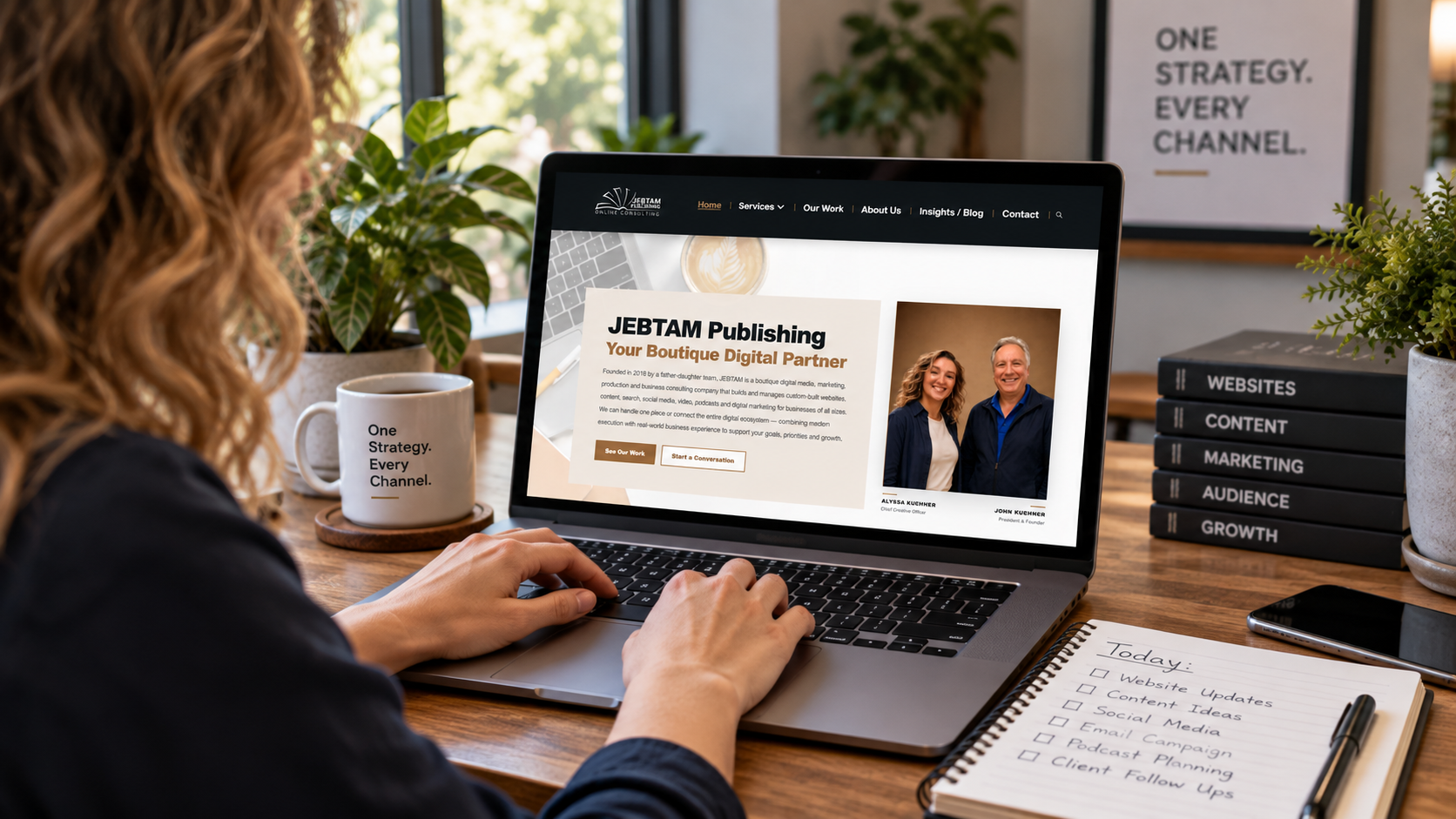
A business website can be beautifully designed, technically sound and completely underused. The problem usually isn’t the website itself. It’s that the business never treats its website as a digital marketing hub connecting search, AI, content, social media, email, video and the other ways customers discover and interact with the company..
The better way to think about your website and digital platform is as a digital marketing hub. It isn’t the entire strategy. It’s the place where the other pieces can connect, support each other and ultimately help turn attention into business. That distinction matters more now because the ways people discover and evaluate businesses are becoming more fragmented.
Your website is important because you control it
Businesses spend a lot of time building audiences on platforms they don’t own. That’s not necessarily a mistake. Search engines, social networks, video platforms and AI tools can all introduce your company to people who might never find it otherwise. But those platforms control the environment. They decide how content gets displayed, what gets recommended, which formats receive attention and when the rules change.
Your website is different. You control the pages, organization, calls to action, depth of information and the path a visitor can take next. You decide how your services are explained, which questions you answer and what someone sees after becoming interested in your business. That makes the website valuable, but ownership alone doesn’t make it a strategy. A website that sits by itself is basically a digital brochure. A website connected to a broader business and digital strategy becomes infrastructure.
Discovery is becoming more fragmented
There was a time when the basic digital path seemed fairly straightforward: someone searched Google, clicked a website and started exploring. That path still exists, but it’s no longer the only one. Someone might first encounter your business through a LinkedIn post, Instagram video, YouTube search, email newsletter, podcast appearance, paid campaign or recommendation from an AI system. They might research you across several of those places before ever reaching your homepage.
Search itself is changing, too. Google now incorporates generative AI experiences such as AI Overviews and AI Mode into search. According to Google’s guidance for AI features and websites, the fundamentals of SEO still apply. Pages need to be accessible and indexable, useful content still matters, and Google specifically recommends making important content easy to find through internal links. There isn’t a separate trick that replaces the fundamentals simply because AI is involved.
At the same time, getting discovered doesn’t always mean getting a click. Pew Research Center analyzed Google searches from 900 U.S. adults during March 2025 and found that users clicked a traditional search result in 8% of visits when an AI summary appeared, compared with 15% when there was no AI summary. Links within the AI summaries themselves were clicked in only 1% of visits.
That’s an important change in behavior. Your business may increasingly be discovered, evaluated or summarized somewhere other than your website. It doesn’t make the website less important. It changes the job the website needs to do, and it’s one reason search and AI strategy shouldn’t be separated from the rest of your digital presence.
The website should give every channel somewhere useful to go
Think about a social post that catches someone’s attention. If the post points to a useful article, service page, video, case study or resource on your website, that person has somewhere to go deeper. They can understand what your company does, see related information and take another step. The social platform created the introduction, but your website continues the conversation in an environment you control.
Email works the same way. A useful newsletter doesn’t have to contain everything. It can introduce an idea and connect readers to deeper material on your site. Video can do it, too. A five-minute video might become an article, a short social clip, an email topic and a useful resource embedded on a relevant web page. The individual channels have different jobs. The website gives those efforts a common destination and a lasting home.
Your content becomes more valuable when it has a home
Good content takes work, which is why publishing it once and moving on is usually a missed opportunity. Imagine a business records a useful conversation with one of its subject-matter experts. That conversation could become a full video, an article explaining the main idea, several short clips, social posts and material for an email newsletter. Instead of producing five unrelated pieces of content, the business develops one useful idea across the channels where its audience spends time.
The website can hold the durable version of that information. Unlike a social post that quickly moves down a feed, a useful web page can remain available to customers, salespeople, search engines and other discovery systems long after it was published. It can link to related services and resources, answer questions in greater depth and be updated as the subject changes. That’s where a deliberate content and publishing strategy starts creating value beyond the individual piece of content.
Google’s newer guidance for generative search goes further on this point. Its 2026 guide to optimizing websites for generative AI search emphasizes unique, useful, non-commodity content rather than simply reproducing information that already exists elsewhere. Google also says businesses don’t need to rewrite everything specifically for AI systems or create countless pages for every possible variation of a search query.
That’s good advice beyond SEO. The website shouldn’t just collect content. It should organize useful knowledge that represents the business well.
Search and AI need something worth finding
There’s plenty of discussion about optimizing for AI search, answer engines, generative engines and whatever acronym comes next. Some of it is useful. Some of it makes a familiar mistake: treating the newest distribution channel as if it exists separately from everything else.
Google’s current position is much less dramatic. SEO remains relevant to its generative AI experiences because those systems still rely on Google’s search index and ranking systems to retrieve relevant web pages. The fundamentals still include technically accessible pages, useful original material, clear site structure and a good experience for the person who eventually arrives.
That points to a larger principle: you can’t build a strong discovery strategy around content that doesn’t exist. If your website clearly explains your expertise, services, people, products and point of view, search and AI systems have more useful material to understand. More importantly, so do actual customers.
The goal isn’t to fill the site with hundreds of thin pages written for algorithms. Google’s Search Essentials continues to emphasize helpful, reliable, people-first content. The better goal is to build a useful body of information that represents the business accurately and answers the questions customers actually have.
Social media should create more than rented attention
Social platforms are valuable because that’s where people already spend time. They can introduce a company, demonstrate expertise and keep a business visible between buying decisions. But attention on a social platform is still attention inside someone else’s system. Algorithms change. Organic reach changes. Formats come and go. An audience you can reach easily today may become harder or more expensive to reach tomorrow.
A connected digital marketing and social media strategy asks how some of that attention can become a deeper relationship. That might mean sending someone to a useful article, inviting them to explore a service, encouraging an email signup or giving them a reason to return directly later.
This doesn’t mean every social post needs a link. That would make social media worse, not better. Some content should simply be useful or interesting where it appears. The point is that social media should have a role in a larger system instead of becoming an endless requirement to keep feeding a platform. We’ve explored that idea in more detail in our guide to social media marketing for small businesses.
Email gives the hub a return path
Websites are excellent destinations, but most people aren’t going to remember to check yours every week. Email marketing helps solve that problem. A useful email program gives a business a direct way to bring interested people back to new articles, videos, services, events or other resources. The website gives email something worthwhile to point toward, while email gives the website a way to reconnect with people who already know the brand.
That’s a much stronger relationship than treating the website and newsletter as unrelated projects. It also shows why audience development matters. Traffic is useful, but a visit can be temporary. An audience that has chosen to hear from you again gives the business an opportunity to continue the relationship instead of starting from zero every time it publishes something.
Video and podcasts shouldn’t live on an island either
The same principle applies to video and podcasting. YouTube, podcast apps and social platforms are valuable distribution channels, but the material created for them can support much more than the platform where it first appears. A useful interview might become an embedded video, article, transcript, email topic, social clips and supporting material for a service page.
A connected video, podcast and media production strategy starts with the idea rather than the upload button. The question isn’t simply, “Where should we post this?” It’s also, “How can this piece of expertise support the rest of the business?”
The real opportunity is in the connections
Marketing conversations often start with a channel. Do we need a new website? Should we be doing more video? What should we post on social media? How do we show up in AI search? Should we start an email newsletter? Those are reasonable questions, but there’s a better one to ask first: How will this connect to what we’re already doing?
A new website won’t fix an unclear message. More social posts won’t solve a weak content strategy. Search optimization can’t manufacture expertise that isn’t demonstrated anywhere. Email can’t nurture an audience if there’s never anything useful to send. Adding another platform to the mix won’t necessarily improve anything if it simply creates another disconnected job for somebody to manage.
When those pieces are planned together, the math changes. An article can support search. The same idea can support video. Video can feed social content. Social can introduce new people to the article. Email can bring existing contacts back to it. The website can connect that visitor to the next relevant service, resource or action. One piece of useful work starts doing several jobs instead of disappearing after its first use.
Measure the system, not just the homepage
Treating the website as a hub also changes what you measure. Website traffic by itself doesn’t tell you whether the strategy is working. Neither do social followers, email opens or video views in isolation. A company can increase traffic without attracting the right customers, build a large social following that produces little business, or publish videos that generate plenty of views without helping the audience understand what the company actually does.
The more useful questions follow the customer journey and the relationships between channels:
- Which channels introduce qualified people to the business?
- Which pages help them understand what you do?
- Which content brings people back?
- Are visitors moving from educational content toward relevant services?
- Are email subscribers becoming repeat readers or customers?
- Are videos and social content creating meaningful visits, inquiries or conversations?
- Which topics repeatedly attract the right audience across several channels?
Not every business needs a complicated attribution model to answer those questions. In many cases, a handful of well-chosen measurements will tell you more than a dashboard filled with disconnected numbers. The goal is to understand whether the pieces are helping people move from discovery to understanding, and eventually to action.
Measurement is also catching up with AI discovery. In 2026, Google introduced dedicated generative-AI performance reporting in Search Console, giving site owners visibility into which pages receive impressions in generative AI features. That’s another reason to think beyond traditional website traffic alone as discovery behavior continues to change.
Build the hub around the business, not the tools
The technology will keep changing. Search has changed. Social platforms will change. AI discovery will keep developing. New publishing and media tools will arrive. A business shouldn’t have to rebuild its entire strategy every time a platform changes direction or a new tool becomes popular.
That’s one reason an owned website remains so useful. It can provide a stable center while the channels around it evolve. Your search strategy may change. The social networks that matter to your audience may change. Email tools may change. AI may create entirely new ways for people to discover your company. But you still need a place where your business can explain what it does, demonstrate what it knows and give interested people a clear next step.
The goal isn’t to be everywhere. It’s to choose the channels that make sense for your customers and make those channels work together. That’s the thinking behind JEBTAM’s approach: One Strategy. Every Channel. The website can be the hub, but the value comes from the connections around it.
If your website, search, content, social media, email and media efforts are operating as separate projects, the first step may not be adding another tactic. It may be figuring out how the pieces you already have should work together. Start a conversation with JEBTAM if you’d like to look at those pieces as one connected digital strategy.
Get JEBTAM Insights in Your Inbox
Practical perspectives on websites, digital strategy, search + AI, content, media and the technology changing how businesses connect with their audiences.
Sign up to receive new JEBTAM Insights as they’re published.