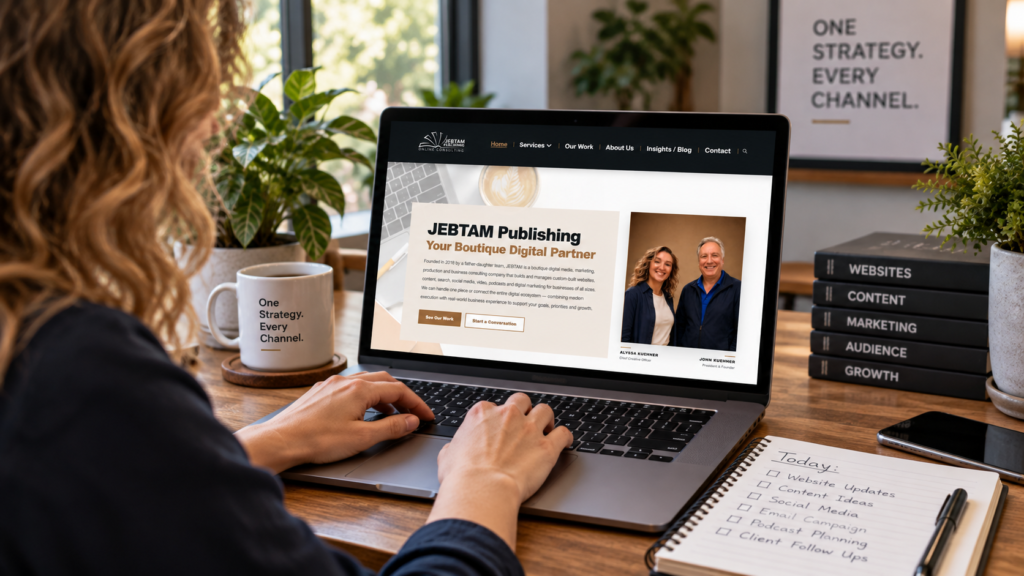

Building a website used to be a project. Increasingly, it can be a prompt. Tell an AI website builder what your business does, who it serves and what kind of look you want, and you can have a surprisingly polished starting point in minutes. Pages, layouts, copy, images, colors and fonts can all appear before you’ve made your second cup of coffee.
That’s real progress, and businesses shouldn’t dismiss it. But it also raises a more important question: If almost anyone can generate a good-looking website, what makes yours worth remembering? That’s where the difference between building a website and building a brand becomes much clearer. AI can help build the website. Your brand comes from the strategy, reputation, expertise and experience behind it.
AI website builders have gotten very good, very quickly
We’re well past the point where AI website builders are just producing rough templates. Wix’s AI website builder can generate pages, sections and visuals from prompts while giving users control over the finished design. Squarespace Blueprint AI can generate layouts, copy, imagery and visual direction based on information about the business and its brand. Webflow’s AI site builder can create a multi-page site along with a foundational design system that can be refined and expanded.
That’s impressive, and it’s useful. For a new business, an internal project, a landing page or a company that has put off replacing an outdated site for years, AI can remove a lot of friction from getting started. It can also make experienced web teams faster by helping with early concepts, structure, repetitive work and first drafts.
But there’s an important phrase buried in all of this: getting started. AI can create the structure, suggest the words, choose attractive colors and assemble a professional-looking page. What it can’t do on its own is decide what your business should mean to people.
A website is something you build. A brand is something people learn.
A website and a brand aren’t the same thing. Your website is a digital platform your business controls. Your brand is the collection of expectations and impressions people develop about your business over time. That means your brand isn’t simply your logo, color palette or homepage design.
Those things help express a brand, but they aren’t the brand itself. Are you expensive or affordable? Innovative or traditional? Specialized or broad? Easy to work with or difficult? Do you understand the customer’s problem, and is there a reason to choose you instead of the five other companies they just found?
Those impressions come from many places. Your website is one of them, but so are your search results, social posts, videos, emails, reviews, sales conversations, customer service and the actual experience of doing business with you. An AI tool can generate a homepage. It can’t independently decide what reputation your company should earn or make every part of the business deliver on that promise.
The problem isn’t AI. It’s generic input.
There’s a temptation to frame this as humans versus AI, but I don’t think that’s particularly useful. AI is a tool, and a very capable one. The bigger risk is asking AI to make strategic decisions before the business has figured out the strategy.
Imagine asking an AI website builder to create a site for a local accounting firm. You tell it the company is professional, trustworthy, experienced and focused on customer service. There’s nothing wrong with any of that, but there’s also very little that distinguishes that accounting firm from hundreds of others.
The same thing happens with contractors, manufacturers, consultants, law firms, medical practices and countless other businesses. If the input consists mostly of broad claims that could describe every competitor, AI has little unique material to work with. It will fill the gaps because that’s what it’s designed to do. The result may look great while saying almost nothing that belongs specifically to you.
Your competitive advantage probably isn’t hiding in a prompt
The valuable work often happens before anyone starts designing the homepage. Why do customers actually hire you? Which customers are the best fit? What do they care about that your competitors overlook? Where does your company have unusual expertise, and what do customers misunderstand about your industry?
Those answers can influence everything from the navigation of a website to its photography, service pages, articles and calls to action. That’s why we look at websites and digital platforms as more than a design exercise. They also give AI better material. If you feed an AI system generic information, you should expect a generic result. Give it a clear strategy, real expertise, original source material and thoughtful direction, and it becomes much more useful.
That’s an important distinction for businesses deciding how much of their website process to automate. The question isn’t simply whether AI can do the work. It’s whether you’ve given it something meaningful to work with.
Search is making originality more important, not less
This matters beyond branding. As AI-generated material becomes easier to produce, search engines are also dealing with an enormous supply of content that can look competent without adding much that’s new. Producing more words is becoming easier. Producing something worth finding is a different challenge.
Google’s guidance for generative AI search recommends creating valuable, non-commodity content and points businesses toward unique viewpoints, first-hand experience and information that adds something beyond material a generative AI model could easily reproduce. Google also continues to emphasize helpful, reliable, people-first content rather than pages created mainly to capture search traffic.
That doesn’t mean AI-generated content is automatically bad for search. Google’s guidance on generative AI content focuses on accuracy, quality and relevance rather than simply whether AI was involved. That’s also why JEBTAM approaches Search + AI as part of a broader digital strategy rather than as a race to generate more pages. When everybody has access to similar AI tools, access to the tool isn’t much of an advantage. Your knowledge is.
What AI can’t build for your brand by itself
AI can assist with almost every part of digital production, but there are several things a business still has to bring to the process. These aren’t technical features you can turn on inside a website builder. They’re the raw materials that make the finished website belong to your business rather than simply look like a business website.
- Positioning: Who you’re for, what makes you different and why someone should choose you.
- Point of view: What your business knows, believes or sees differently because of real experience.
- Proof: Actual work, expertise, customer experiences, results, credentials and other evidence behind your claims.
- Judgment: Knowing what to say, what not to say and which ideas deserve attention.
- Consistency: Making sure the experience holds together across your website, search presence, social media, email, content and real-world customer interactions.
AI can help organize, develop and communicate those things. It shouldn’t be expected to invent them. That’s why the quality of an AI-built website still depends heavily on the thinking that happens before and around the technology.
The website has to connect to something bigger
This is where we think businesses need to look beyond the website itself. A website rarely works in isolation. Someone might discover your company through Google, an AI-generated answer, LinkedIn, Instagram, YouTube, a podcast, an email newsletter or a referral. They may visit your website, leave, encounter you somewhere else and come back weeks later.
Each interaction either reinforces the same impression or creates a new one. If your website presents the company one way, social media another way and email another, the problem isn’t really web design. It’s a disconnected digital strategy.
The opposite is also true. A strong idea can become much more valuable when it moves consistently across channels. A useful article can support search visibility, become several social posts, provide material for an email, inspire a video and give a salesperson something meaningful to share with a prospect. Good content and publishing can give all of those channels something worthwhile to work with, while the website becomes the home for that material rather than an isolated online brochure.
That’s the thinking behind JEBTAM’s approach: One Strategy. Every Channel. The channels don’t all need to be managed the same way, and every business doesn’t need to be everywhere. But the channels you do use should reinforce the same digital strategy and make sense together.
So, should you use AI to build your website?
In many cases, yes. Use AI where it saves time. Let it help generate concepts, explore layouts, organize information, create drafts, handle repetitive tasks and speed up production. Just don’t confuse faster production with finished strategy.
Before publishing an AI-built website, ask a few harder questions:
- Does this site sound like our business or like any business in our category?
- Does it explain why the right customer should choose us?
- Are the claims based on something real and defensible?
- Does the site contain useful knowledge competitors can’t simply copy?
- Does the experience match what customers encounter in our other channels?
- Have we given people a reason to remember us after they close the browser?
If those answers are weak, changing the font or asking AI for another version probably won’t solve the problem. You may end up with a different-looking version of the same generic message. The strategy needs work.
AI changes the work. It doesn’t eliminate the thinking.
There was a time when simply having a professional website separated a business from some of its competitors. That bar is getting lower quickly, and I think that’s ultimately a good thing. Businesses can spend less time wrestling with basic production and more time thinking about what deserves to be produced in the first place.
AI can help turn that thinking into a website faster than we’ve ever been able to do before. But the business still needs a point of view. It still needs credibility, an understanding of its customers and a consistent experience after somebody leaves the homepage.
The website matters. But the website isn’t the brand. It’s one of the places where the brand has to prove itself.
If you’re rethinking your website and want the technology, content, search strategy and other digital channels to work as one system, talk with JEBTAM about what you’re building. The strategy should come before deciding which tools should build it.
Get JEBTAM Insights in Your Inbox
Practical perspectives on websites, digital strategy, search + AI, content, media and the technology changing how businesses connect with their audiences. Sign up to receive new JEBTAM Insights as they’re published.
Signup functionality placeholder — form or subscription component to be added when available.