Social Media Has Become a Discovery Engine
Social media marketing for small business has changed significantly from the days when success meant creating a Facebook page, posting regularly and trying to accumulate followers. Social platforms are now places where people discover businesses, search for information, evaluate brands, watch video, follow personalities and decide what deserves their attention. That creates a significant opportunity for businesses, but simply being active on social media isn’t the same as having a strategy. At JEBTAM, we view Digital Marketing + Social Media as one part of a larger digital ecosystem connecting your website, content, search visibility, email audience, video, brand and the customer journey between them. Social media can create attention; the larger opportunity is turning that attention into something your business can build on.
One of the biggest changes in social media is the way people use these platforms to find information. Traditional search engines remain enormously important, but social platforms increasingly function as discovery and search environments themselves. Recent Sprout Social research describes social as the second-most-used search environment among the consumers it surveyed, behind traditional search engines, with younger audiences particularly likely to spread discovery across search engines and social platforms.
A restaurant may be discovered through an Instagram Reel, a professional may establish authority through LinkedIn, a local business may reach someone through Facebook, and an interview or demonstration may surface through YouTube. Recommendation algorithms also mean that content can reach people who have never followed the account publishing it, making discoverability increasingly important. The question for a business is no longer simply, “How many followers do we have?” It is increasingly, “Can the right people discover us when what we offer is relevant to them?”
Social Media Is Becoming Part of Search Strategy
That evolution is also bringing social media, traditional SEO and AI-driven discovery closer together. Businesses should think about the words and questions customers actually use when searching for information and incorporate those subjects naturally into profiles, captions, video titles, spoken content, on-screen text and the supporting content on their websites. Social platforms can interpret far more context than a caption alone, while Google continues developing ways to understand and surface information connected to creators, websites and social platforms. This is why JEBTAM’s Search + AI work isn’t isolated from social media. A strong website, useful articles, video, social content and clearly structured information can reinforce one another and help both people and increasingly sophisticated discovery systems understand who your business is, what it does and why it may be relevant.
Your Website Should Remain the Digital Foundation
Social platforms can be powerful discovery channels, but businesses should be careful about building their entire digital presence on platforms they don’t control. Algorithms change, organic reach changes, advertising costs change, platform rules change, and a network that matters enormously today may become less important several years from now.
Your website is different because it is an asset your business controls—one where someone can understand who you are, explore your services, read your expertise, watch your media, contact you, subscribe to your email list or take the next step toward becoming a customer. That’s why JEBTAM treats Websites + Digital Platforms as the foundation of the digital ecosystem rather than simply another marketing channel. A strong social post doesn’t have to be the end of the journey; it can be the beginning of a path from discovery to website visit, useful content, direct audience relationship and eventually a business opportunity.
Followers Matter, but the Right Audience Matters More
Follower counts are easy to understand, which is probably one reason businesses focus so heavily on them, but the size of an audience tells only part of the story. A large following that rarely engages with a business may be less valuable than a smaller audience that watches, clicks, shares, asks questions, subscribes, visits the website and ultimately becomes customers. Recommendation-driven feeds have also made follower counts less predictive of how widely individual content can travel because platforms routinely expose users to content from accounts they do not follow. Instead of measuring success only by follower growth, businesses should ask who they are reaching and what those people do next. Depending on the objective, useful measurements may include website traffic, video engagement, shares, qualified comments, direct messages, email subscriptions, inquiries, appointments, leads or sales.
Create Content People Actually Want
The rapid growth of generative AI has made it easier than ever to produce enormous amounts of content, but easier production doesn’t automatically create better content. In an increasingly crowded environment, authentic expertise, recognizable people, useful information, original experiences and strong storytelling can become even more valuable. A smaller business often possesses something larger organizations spend substantial amounts trying to manufacture: genuine personality and direct expertise. Show the owner, answer a customer’s question, take people behind the scenes, explain something complicated, interview someone interesting, demonstrate how something works or talk intelligently about what’s happening in your industry or community. JEBTAM’s Content + Publishing approach is built around that idea—create material that is genuinely useful or interesting first, then determine how to distribute and adapt it for the channels where it belongs.
One Strong Idea Can Feed Multiple Channels
Businesses often tell us they don’t have enough time to constantly create content, but the solution isn’t necessarily producing dramatically more original material. Often it is getting more value from what is already being created. A thoughtful article can become newsletter content, LinkedIn material, Facebook posts, Instagram content, short-form video or the basis for a deeper discussion. A podcast interview can become a full video episode, an audio program, several short clips, an article, a newsletter feature and multiple social posts. That’s one reason our Podcast + Video + Media Production work is connected so closely with content and social media. The objective isn’t to copy and paste exactly the same thing everywhere; it is to start with strong source material and intelligently adapt it for different audiences, formats and platforms.
Organic and Paid Social Should Work Together
Organic social media and paid promotion serve different purposes, and businesses don’t necessarily have to choose between them. Organic publishing helps establish presence, personality, credibility and an ongoing relationship with an audience, while paid promotion can extend strong content or a specific offer to a more targeted group of people. The mistake is assuming that paying to distribute mediocre content automatically turns it into an effective campaign. Paid reach cannot fix an unclear message, weak offer, poor landing page or confusing customer journey. Start with the business objective: Who are we trying to reach? What do we want them to understand? What should they do next? Where should the click take them? How will we know whether it worked? Only then does it make sense to determine whether organic distribution, paid promotion or a combination of both is appropriate.
You Don’t Need to Be Everywhere
Another common mistake is assuming that every business needs an equally active presence on every social platform. The right mix depends on the audience, business model, available content and objective. Facebook may be valuable for local businesses, communities, events and consumer audiences; Instagram can work particularly well for visual brands, personalities, hospitality and short-form video; LinkedIn can be highly relevant for B2B organizations, professional services and thought leadership; YouTube combines search, long-form video, demonstrations, interviews and evergreen content; and TikTok can offer substantial discovery when the audience and content fit the platform. The objective isn’t to check every social-media box. It’s to identify the channels that make sense for the business, develop a manageable publishing rhythm and execute those channels well.
Build an Audience You Can Reach Directly
Social platforms provide access to enormous audiences, but the relationship between a business and its followers still depends on the platform. An opted-in email subscriber creates a different kind of connection because that person has explicitly asked to hear directly from the business. That is why JEBTAM connects social strategy with Email Marketing + Audience Monetization. Social can help someone discover you, your website can give them a reason to learn more, useful content can establish credibility, and email can create an ongoing relationship that doesn’t depend entirely on a social algorithm deciding whether your next post appears in someone’s feed. That is a much more durable digital asset than simply accumulating likes.
Measure Business Outcomes, Not Just Activity
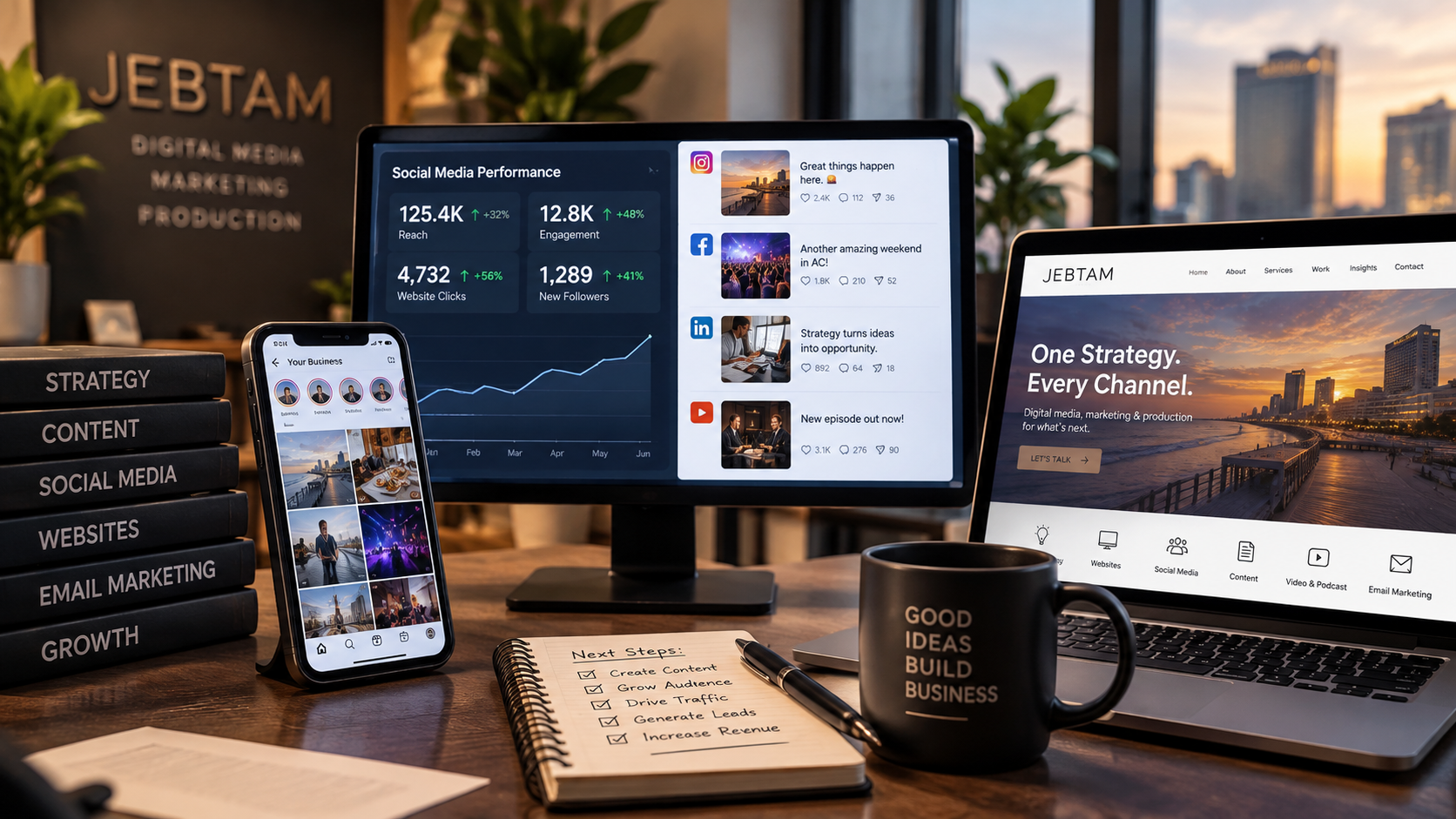
A social-media report filled with impressions, likes and follower counts may look impressive while telling you very little about whether the marketing is helping the business. Measurement should start with the objective. If the goal is awareness, reach and qualified video views may matter; if the goal is website discovery, referral traffic and engaged visits become more important; if you’re building a direct audience, subscriptions matter; and if you’re trying to generate new business, inquiries, appointments, purchases or qualified leads may be the real measures of success. Analytics should therefore be part of the strategy from the beginning rather than a report produced after the campaign is over. Plan, publish, measure, learn and improve.
The Bigger Opportunity Is Connecting the Pieces
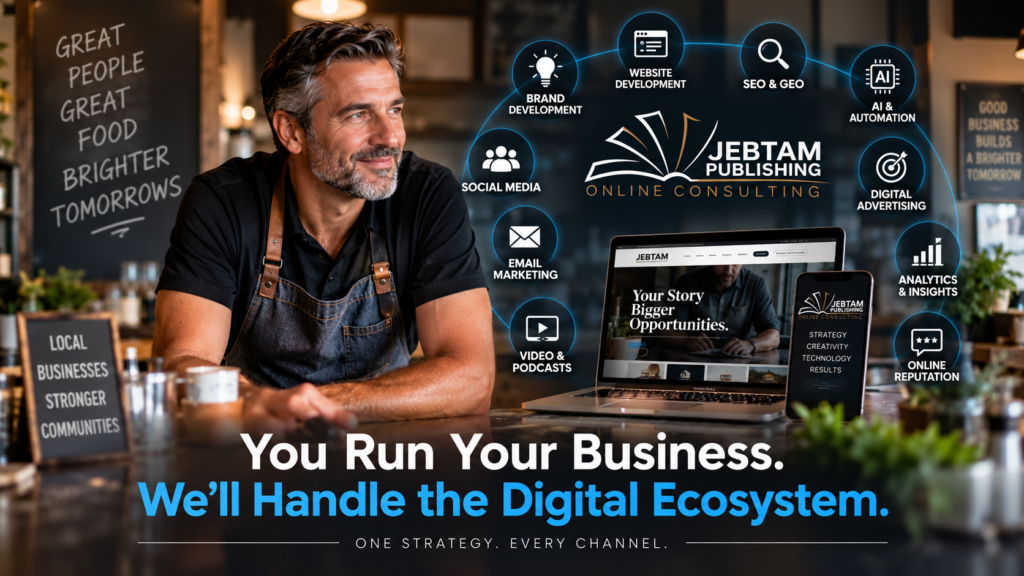
The strongest digital presence isn’t a collection of disconnected accounts. It’s an ecosystem in which each channel has a job. Your website provides a digital foundation, useful content gives people something to discover, search helps them find it, social extends its reach, video makes expertise and personality visible, email creates a direct audience, and analytics helps determine what is actually working. That connected model is ultimately what JEBTAM’s Digital Presence Management service is designed around. A business may need only one of these capabilities, and that’s perfectly fine. Or JEBTAM can connect several of them around a specific objective and help manage the broader system over time.
Social Media Should Lead Somewhere
Social media remains an important opportunity for businesses in 2026, but its real value isn’t simply posting more often or chasing a larger follower count. The opportunity is using social strategically to create discovery, communicate expertise, reach the right audiences and give those people a logical next step. Sometimes that next step is watching another video or following the account; sometimes it’s visiting the website, reading an article, joining an email list, making an inquiry or becoming a customer. The strategy should begin with what the business is trying to accomplish and work backward from there. If your business is active on social media but isn’t sure how those efforts connect to website traffic, content, search visibility, audience growth or measurable business opportunities, explore JEBTAM’s Digital Marketing + Social Media capabilities or start a conversation about what you’re trying to accomplish.